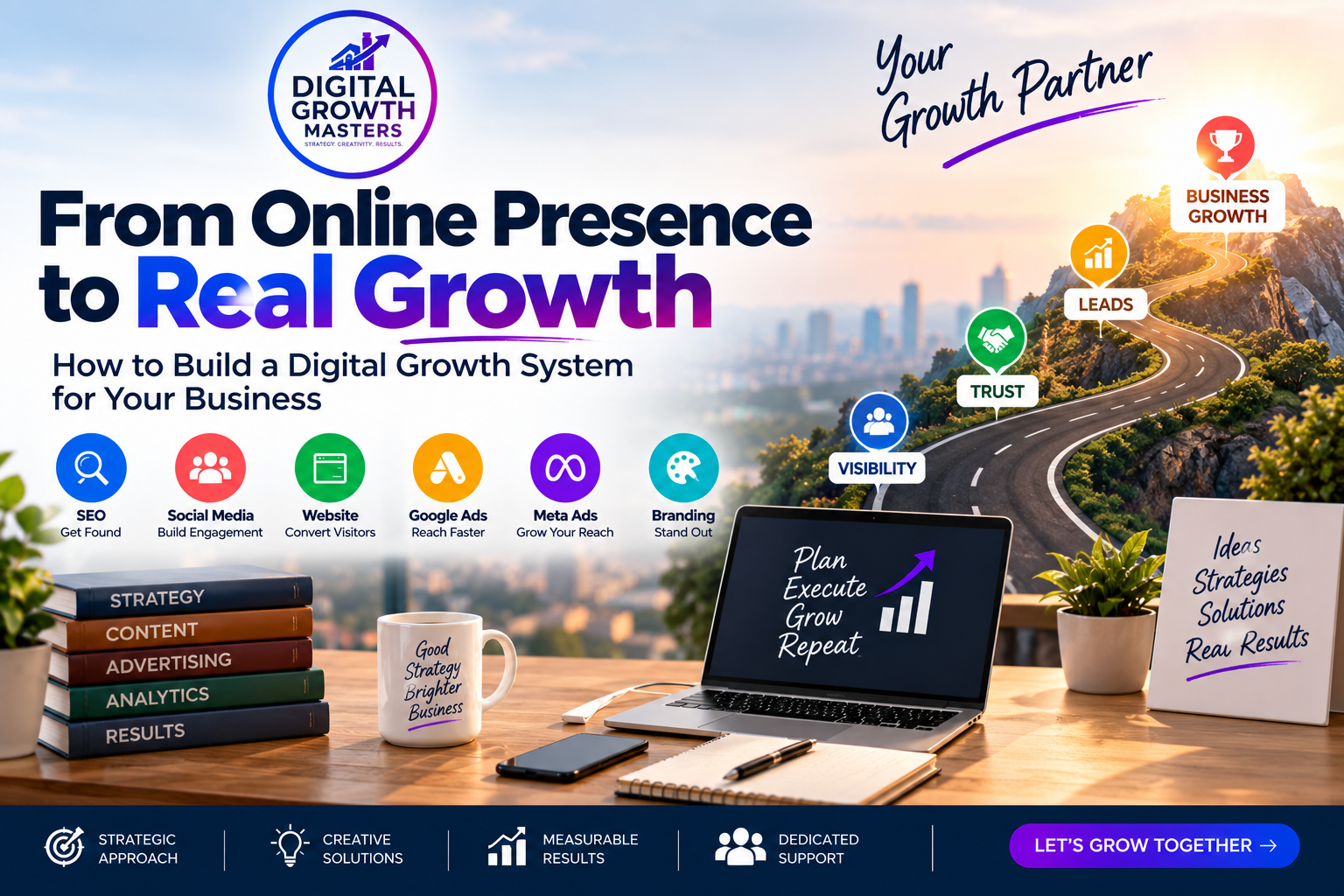
From Online Presence to Real Growth: How to Build a Digital Growth System for Your Business
Having a website, an Instagram page, a Google Business Profile, or running advertisements does not automatically mean a business has a strong digital presence.
Many businesses are active online but still struggle to generate consistent enquiries, sales, or customer engagement.
The reason is simple: digital marketing works better when different activities work together as a system rather than operating separately.
A business may have good social media content but poor website conversion. Another may run Google Ads but fail to follow up with leads. Some businesses invest in SEO but do not create content that answers what their customers are actually searching for.
Real digital growth comes from connecting these different pieces.
In this guide, we will look at how businesses can build a digital growth system that connects visibility, trust, engagement, leads, and conversions.
What Is a Digital Growth System?
A digital growth system is a connected approach where different online marketing activities support the same business goal.
Instead of thinking:
SEO + Instagram + Website + Ads
think:
Visibility → Attention → Trust → Enquiry → Conversion → Retention
Each stage has a purpose.
For example, a potential customer may first discover your business through Google. They may then visit your website, check your Instagram profile, read reviews, compare your services, and finally contact you.
If any important step is weak, you may lose that customer.
This is why businesses need more than individual marketing activities. They need a strategy that connects them.
1. Start With a Clear Business Goal
Before investing in digital marketing, define what you actually want to achieve.
Is your priority:
- More enquiries?
- More online sales?
- More calls?
- More website visitors?
- More local customers?
- Better brand awareness?
- More qualified leads?
- Growth in a new market?
Your objective determines your strategy.
For example, an e-commerce business may focus heavily on product pages, Meta Ads, Google Ads, remarketing, and conversion optimization.
A local service business may need stronger Google visibility, a professional website, reviews, social proof, and lead-generation campaigns.
There is no single digital marketing strategy that works exactly the same way for every business.
2. Build a Website That Works as Your Digital Sales Office
Your website is often one of the most important assets in your digital ecosystem.
But simply having a website is not enough.
A good business website should quickly answer:
What do you offer?
Who do you help?
Why should customers trust you?
How can they contact you?
Your website should also have clear calls to action.
Instead of making visitors search for your contact information, give them obvious options such as:
- Get a Quote
- Book a Consultation
- Call Now
- Send an Enquiry
- WhatsApp Us
- Request a Callback
Your website should not just look professional.
It should make the next step easy.
3. Use SEO to Build Long-Term Visibility
Search engines can become a powerful source of relevant traffic when your website provides useful answers to customer searches.
SEO should not be treated as simply adding keywords to pages.
A strong SEO strategy can include:
- Keyword research
- Helpful website content
- Technical SEO
- On-page optimization
- Internal linking
- Local optimization
- Content marketing
- Website performance
- Search intent analysis
The goal is to create content that genuinely helps people while making it easier for search engines to understand your business.
For example, instead of creating a generic article about your service, answer questions your potential customers are actually asking.
This creates a stronger connection between what people search for and what your business provides.
4. Turn Social Media Into a Trust-Building Channel
Social media is not only about posting regularly.
Your content should help people understand your brand.
A strong content strategy can include:
Educational content – Teach something useful.
Problem-solving content – Address common customer problems.
Behind-the-scenes content – Show the people and process behind your business.
Customer-focused content – Demonstrate how your product or service solves real problems.
Brand content – Communicate your personality, values, and expertise.
Offer-based content – Promote relevant products, services, or offers.
The objective is not necessarily to make every post go viral.
The objective is to make the right people remember your business and trust it.
5. Use Google Ads and Meta Ads Strategically
Organic marketing takes time.
Paid advertising can help businesses reach specific audiences faster, but advertising without a strategy can become expensive.
Before launching an advertising campaign, think about:
Who are we targeting?
What problem are we solving?
What offer are we presenting?
Where will the customer land after clicking?
What happens after they submit an enquiry?
For example, sending paid traffic to a confusing homepage may waste the opportunity.
A dedicated landing page with a clear offer and simple enquiry process can create a more focused customer journey.
The advertisement gets attention.
The landing page builds the case.
The enquiry process converts interest into an opportunity.
6. Make Branding Consistent Across Every Platform
Imagine seeing a business on Instagram with one style, visiting its website with completely different colours and messaging, and then finding another tone on Google.
It can create confusion.
Your brand should feel connected across:
- Website
- Google Business Profile
- Advertisements
- Email communication
- Marketing materials
Consistency helps customers recognize your business more easily.
Branding is not only about a logo.
It includes your visual identity, messaging, tone, positioning, and customer experience.
7. Create Content Around Customer Problems
One of the biggest opportunities in digital marketing is creating content around questions people already have.
Instead of constantly saying:
“We provide the best service.”
create content that answers:
“How do I solve this problem?”
For example:
- How can I improve my website?
- Why are my ads not generating enquiries?
- How can I get more customers from Google?
- What should I post on Instagram?
- How much does a website cost?
- How can I improve my online presence?
- How can I generate better-quality leads?
Helpful content can attract people before they are ready to buy.
That means your business can become part of their research journey.
8. Use Data Instead of Guesswork
Digital marketing provides something traditional marketing often cannot provide at the same level: measurable data.
You can track:
- Website traffic
- Search visibility
- Ad performance
- Enquiries
- Conversion rates
- Social media engagement
- Landing-page performance
- Customer acquisition sources
But collecting data is not enough.
The important question is:
What should we change based on the data?
If an advertisement gets clicks but very few enquiries, investigate the landing page and offer.
If a page gets traffic but users leave quickly, review the content and user experience.
If a campaign generates many enquiries but few conversions, examine lead quality and follow-up.
Data should lead to decisions.
9. Use AI to Improve Marketing — Not Replace Strategy
AI is changing how businesses create content, analyze information, automate tasks, and support customers.
Businesses can use AI for activities such as:
- Content research
- Idea generation
- Customer communication
- Data analysis
- Workflow automation
- Content personalization
- Marketing assistance
But AI should support human strategy rather than replace it completely.
Your customers still need authentic information, useful experiences, accurate communication, and a reason to trust your business.
The competitive advantage is not simply using AI.
It is knowing where AI can improve your business and where human expertise is still essential.
10. Connect Everything Into One Customer Journey
This is where a digital growth system becomes powerful.
Imagine this journey:
A customer searches for a solution on Google.
They discover your website.
They read your content.
They visit your social media profile.
They see useful posts and customer feedback.
Later, they see your advertisement.
They click through to a focused landing page.
They submit an enquiry.
Your team follows up.
The customer becomes a client.
Now SEO, content, social media, website development, advertising, branding, analytics, and sales follow-up are no longer separate activities.
They are working together.
That is the difference between simply being online and building a digital growth system.
Why Businesses Need an Integrated Digital Strategy
Digital marketing becomes more complicated when every platform is managed independently.
Your website team may focus only on design.
Your SEO team may focus only on rankings.
Your social media team may focus only on engagement.
Your advertising team may focus only on clicks.
But the business owner ultimately wants one thing:
business growth.
An integrated strategy brings these activities together around measurable business objectives.
At Digital Growth Masters, we work across SEO, Social Media Marketing, Website Development, Google Ads, Meta Ads, Branding, Content Marketing, Analytics, AI-powered marketing solutions, and lead-generation strategies.
Our approach is focused on understanding the business first and then building a digital strategy around its goals, audience, market, and customer journey.
Our practical experience includes projects such as City Chandan Jewellers, SAS Infra, and Latest Gadgets, giving us experience across different types of businesses and digital requirements.
Final Thoughts
Your business does not need to be everywhere just for the sake of being everywhere.
It needs to be visible in the right places, useful to the right audience, trustworthy when customers research you, and easy to contact when they are ready to take action.
That is what a strong digital growth system should accomplish.
SEO can bring visibility.
Content can build authority.
Social media can create engagement.
Your website can build trust.
Paid advertising can accelerate reach.
Branding can create recognition.
Analytics can guide decisions.
AI can improve efficiency.
But the real opportunity comes when all of these work together.
If your business has been investing in digital marketing but your online activities still feel disconnected, it may be time to stop looking at individual platforms and start building a complete digital growth system.
Digital growth is not about doing more marketing.
It is about making your marketing work better together.
Ready to Build Your Digital Growth Strategy?
If you want to strengthen your business’s online presence with a connected strategy covering SEO, Social Media, Website Development, Google Ads, Meta Ads, Branding, Content, Analytics and AI-powered marketing, connect with Digital Growth Masters.
Website: https://digitalgrowthmasters.in/
Digital Growth Masters — Strategy. Creativity. Results.