Running a small business in India is becoming increasingly competitive. Whether you own a restaurant, salon, coaching institute, retail shop, real estate business, professional service or e-commerce store, your customers are likely using the internet to discover businesses, compare options and make purchasing decisions.
This is where digital marketing can help.
Digital marketing is not simply about posting regularly on Facebook or Instagram. A successful digital marketing strategy connects your website, search engines, social media, online advertising, content and customer enquiries to achieve a clear business goal.
For small businesses, the goal should be simple:
Get your business in front of the right people, build trust and convert interested people into customers.
In this guide, we explain how small businesses in India can build a practical digital marketing strategy.
What Is Digital Marketing?
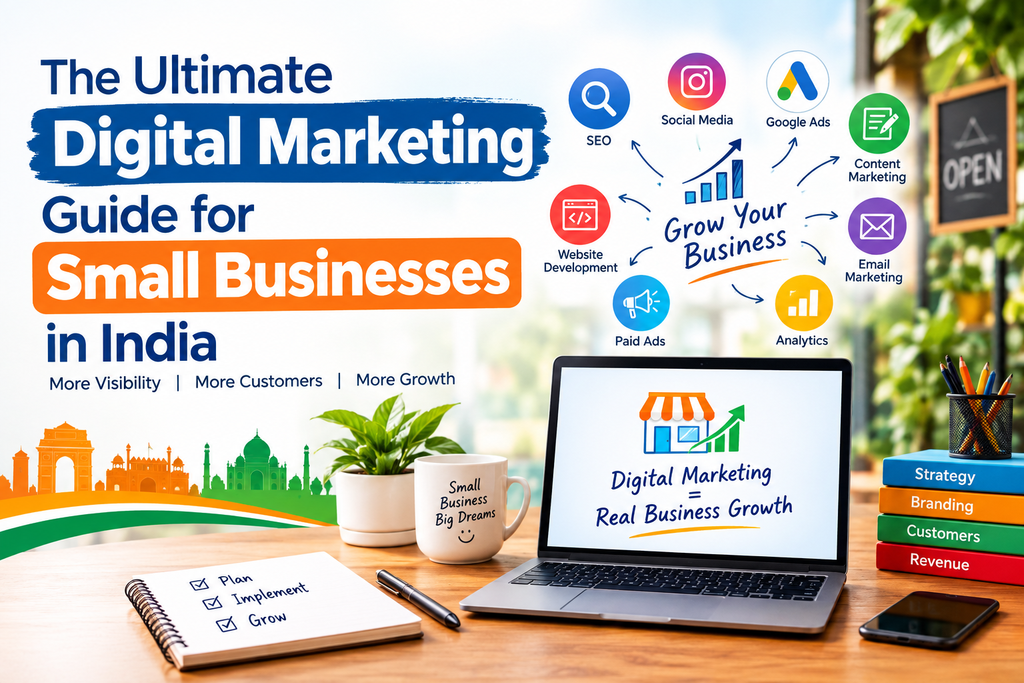
Digital marketing means promoting your business through online channels such as:
Different channels serve different purposes.
For example:
SEO helps people discover your business through search engines.
Google Ads can put your business in front of people actively searching for specific products or services.
Meta Ads can help businesses reach selected audiences on Facebook and Instagram.
Social media marketing helps build visibility, engagement and trust.
A good website gives potential customers more information and encourages them to enquire or buy.
Why Digital Marketing Is Important for Small Businesses
Large companies often have big advertising budgets, but small businesses can still compete by being more focused.
Instead of trying to reach everyone, you can target:
For example, a restaurant in Bhubaneswar does not necessarily need to advertise to people across India.
It may be more useful to reach people who live or work near the restaurant and are interested in food and dining.
This is one of the major advantages of digital marketing.
1. Define Your Target Audience
Before spending money on advertising, understand who your customers are.
Ask yourself:
Who is my ideal customer?
Consider:
For example, a coaching institute may target students and parents, while a B2B service provider may target business owners and decision-makers.
The clearer your target audience is, the easier it becomes to create relevant content and advertisements.
2. Build a Professional Website
Your website is often the central point of your digital presence.
Social media profiles are useful, but you should not depend entirely on third-party platforms.
A professional business website should clearly explain:
Important website pages
A small business website should generally have:
Your Website Should Be Mobile-Friendly
Many users access websites from smartphones.
Therefore, your website should:
Useful CTA buttons include:
Call Now
WhatsApp Us
Get a Free Consultation
Request a Quote
Book an Appointment
3. Start Search Engine Optimization
Search Engine Optimization, commonly called SEO, helps improve your website’s visibility in search engines.
Suppose someone searches:
“SEO company in Bhubaneswar”
If your business provides SEO services in Bhubaneswar, you would want your website to appear when relevant people search for that service.
SEO generally includes:
4. Focus on Local SEO
Local SEO is particularly important for businesses that serve a specific location.
Examples include:
Optimize your online presence for searches related to your location.
For example:
Digital Marketing Agency in Bhubaneswar
SEO Services in Bhubaneswar
Best Salon in Bhubaneswar
Restaurant near me
Your location, services and business information should be presented accurately and consistently.
5. Optimize Your Google Business Profile
For local businesses, Google Business Profile should be an important part of the marketing strategy.
Keep your profile updated with:
Encourage genuine customers to leave reviews after using your service.
Reviews can help potential customers understand other people’s experiences with your business.
6. Use Social Media Marketing
Social media can help small businesses build awareness and relationships with potential customers.
Depending on your audience, useful platforms may include:
You don’t need to be active on every platform.
Choose platforms where your potential customers actually spend time.
What Should You Post?
Avoid making every post a sales advertisement.
Create different types of content.
Educational content
Teach your audience something useful.
Example:
5 SEO Mistakes Small Businesses Should Avoid
Problem-solving content
Address customer problems.
Example:
Why Is Your Website Getting Visitors but No Enquiries?
Product/service content
Explain what you offer.
Testimonials
Show real customer experiences.
Case studies
Show what you did and the measurable results, where you have genuine data.
Behind-the-scenes content
Show the people and processes behind your business.
Promotional content
Use offers and promotions when appropriate.
7. Use Meta Ads
Meta Ads can help businesses reach audiences through Facebook and Instagram.
Businesses can use advertising for objectives such as:
For example, a coaching institute could run advertisements targeting parents in a specific location.
A salon could promote an offer to people in nearby areas.
A real estate business could generate enquiries for a specific property.
8. Use Google Ads
Google Ads can be useful when potential customers are actively searching for products or services.
For example:
“website development company near me”
“digital marketing agency Bhubaneswar”
“best coaching institute near me”
The advantage is that your advertisement can appear when someone is already looking for something related to your business.
However, successful Google Ads campaigns require proper:
9. Create Valuable Content
Content marketing is an important part of long-term digital growth.
Don’t create content simply because you need to publish something.
Create content that answers your customer’s questions.
For example, a digital marketing company can publish:
A restaurant could publish:
The key is to connect your content with what your target customers actually want to know.
10. Use Email and WhatsApp Marketing
Not every customer will purchase the first time they discover your business.
Follow-up can therefore be important.
Depending on your business and customer consent, you can use:
For example, someone may enquire about a service today but purchase several weeks later.
A proper follow-up process can help prevent potential customers from being forgotten.
11. Build Your Online Reputation
Customers often research a business before making a decision.
Your online reputation can include:
Ask satisfied customers for genuine feedback.
Don’t create fake reviews or misleading claims.
Trust takes time to build and can be damaged quickly.
12. Build Quality Backlinks
Backlinks are links from other websites pointing to your website.
For SEO, the quality and relevance of links matter more than simply collecting a large number of links.
For example, a relevant business website linking to your article can be more valuable than hundreds of unrelated low-quality links.
You can work toward earning backlinks through:
Avoid buying large quantities of spammy backlinks.
13. Create Industry-Specific Content
One effective strategy for small businesses is to create content around specific customer groups.
For example, a digital marketing agency could create:
Digital Marketing for Restaurants
Explain:
Similarly:
Digital Marketing for Salons
Digital Marketing for Coaching Institutes
Digital Marketing for Real Estate
Digital Marketing for E-commerce
Digital Marketing for Gyms
This allows your website to address specific business problems instead of publishing only generic content.
14. Track Your Digital Marketing Results
Don’t judge your marketing only by likes and followers.
Track metrics that connect to business results.
SEO
Social Media
Advertising
Website
15. Don’t Focus Only on Followers
A business with 5,000 followers isn’t necessarily more successful than a business with 500 followers.
The important question is:
Are the right people discovering your business and taking action?
For a small business, 20 qualified enquiries can be more valuable than thousands of irrelevant views.
Focus on:
Visibility → Engagement → Enquiries → Customers
16. Create a Simple Digital Marketing Funnel
A good digital strategy should move people through different stages.
Stage 1: Awareness
People discover your business.
Channels:
↓
Stage 2: Interest
They learn more about your business.
Channels:
↓
Stage 3: Consideration
They compare your business with alternatives.
Helpful elements:
↓
Stage 4: Conversion
They take action.
Examples:
↓
Stage 5: Retention
Continue communicating with existing customers.
17. Common Digital Marketing Mistakes
Small businesses should avoid these common mistakes:
❌ Posting without a strategy
Random posts rarely create consistent business results.
❌ Targeting everyone
A broad audience can waste advertising money.
❌ Ignoring SEO
You may miss people actively searching for your services.
❌ Having a poor website
Advertising traffic is wasted if visitors cannot understand what you offer.
❌ Buying fake followers
Follower numbers do not guarantee customers.
❌ Buying spam backlinks
Poor-quality links can create SEO problems.
❌ Not tracking conversions
Without tracking, you don’t know which marketing activities generate leads.
❌ Expecting immediate SEO results
SEO is generally a long-term activity.
❌ Using the same content everywhere
Different platforms have different audiences and content formats.
18. How Much Should a Small Business Spend on Digital Marketing?
There is no single budget that works for every business.
Your budget should depend on:
A small business could start with a manageable budget, measure the results and gradually increase investment in channels that generate qualified leads.
The important thing is not simply:
How much are you spending?
Instead ask:
What business result are you getting from that spending?
19. A Simple Digital Marketing Strategy for a Small Business
If you’re just starting, follow this basic framework:
Step 1
Define your target customer.
Step 2
Build or improve your website.
Step 3
Create and optimize your Google Business Profile.
Step 4
Set up social media profiles.
Step 5
Start creating useful content.
Step 6
Begin SEO.
Step 7
Test Google Ads or Meta Ads if paid advertising fits your business.
Step 8
Set up lead tracking.
Step 9
Collect genuine reviews and testimonials.
Step 10
Review your results every month and improve your strategy.
20. Digital Marketing Is a Long-Term Process
Digital marketing is not a one-time activity.
Your competitors are creating content, running advertisements, improving websites and building their online presence every day.
Your strategy should therefore continuously evolve.
A strong digital presence combines:
SEO + Website + Content + Social Media + Paid Ads + Local SEO + Lead Generation + Analytics
The exact combination depends on your business.
How Digital Growth Masters Can Help
At Digital Growth Masters, our focus is to help businesses build a stronger digital presence, reach the right audience and grow online. We work as a team of six digital professionals and have worked together under the Digital Growth Masters brand for around one year, completing digital marketing work for several clients.
Our services include:
Our approach is based on understanding the business first, identifying the target audience, creating a customized strategy and combining different digital channels rather than treating each activity separately. Our core approach is:
Strategy + Creativity + Technology + Performance
Final Thoughts
Digital marketing gives small businesses in India the opportunity to compete for attention online without needing the marketing resources of a large corporation.
The key is not to use every digital channel simply because it exists.
Instead:
Understand your customers.
Choose the right channels.
Create useful content.
Build a professional website.
Improve your Google visibility.
Use paid advertising carefully.
Track enquiries and conversions.
Keep improving based on results.
A consistent and customer-focused digital marketing strategy can help your business build visibility, generate enquiries and create stronger relationships with customers over time.
Ready to Grow Your Business Online?
Digital Growth Masters
Grow Smarter. Reach Further. Convert Better.
Need help with SEO, Google Ads, Meta Ads, social media, website development or lead generation?
👉 Contact Digital Growth Masters for a digital marketing consultation.