
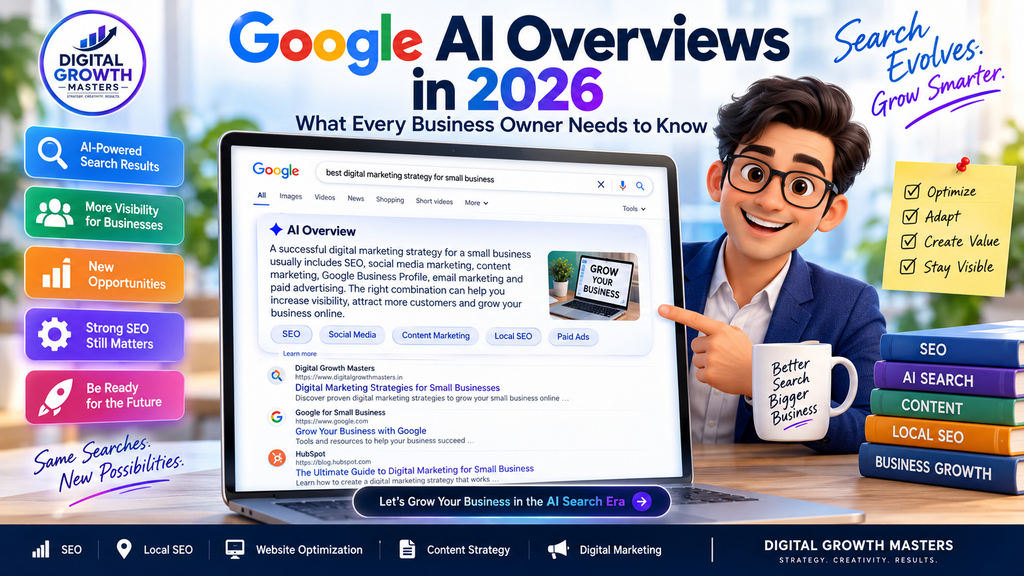
Google AI Overviews are changing the way people search, discover businesses and make decisions online. In 2026, businesses can no longer focus only on traditional Google rankings—they also need to understand how their content can be discovered through AI-powered search experiences.
In this guide, we explain what Google AI Overviews are, how they affect SEO, how businesses can optimize their websites for AI-powered search, and what you should do now to improve your online visibility.
For business owners, this creates both a challenge and a major opportunity.
Instead of displaying only a traditional list of blue links, Google can now provide an AI-generated overview of a topic, supported by links to relevant websites. Google says AI Overviews now reach more than 2.5 billion monthly active users, while AI Mode has surpassed 1 billion monthly users globally.
So the important question for businesses is no longer simply:
“How do I rank #1 on Google?”
It is increasingly:
“How do I make my business and content visible when Google uses AI to answer a customer’s question?”
This guide explains Google AI Overviews, how AI Search works, what it means for SEO, and what businesses should do in 2026 to improve their chances of being discovered.
SEO Information for This Blog
Primary Focus Keyword:
Google AI Overviews
Secondary Keywords:
Search Intent: Informational + Commercial Investigation
Suggested SEO Title:
Google AI Overviews in 2026: What Every Business Owner Needs to Know
Suggested URL:
/blog/google-ai-overviews-2026-business-guide/
Meta Description:
Learn how Google AI Overviews are changing SEO in 2026 and discover practical strategies businesses can use to improve visibility in AI-powered Google Search.
Suggested Image Alt Text:
Google AI Overviews 2026 and AI search optimization for businesses
What Are Google AI Overviews?
Google AI Overviews are AI-generated summaries that can appear at the top of Google Search for certain queries.
Instead of requiring users to open multiple webpages to understand a topic, Google can provide an AI-generated overview and include links to supporting webpages.
Google describes AI Overviews as a way to help people understand complicated topics more quickly while providing links that allow them to explore further.
For example, imagine someone searches:
“What is the best digital marketing strategy for a small business?”
Instead of seeing only traditional search results, Google may provide an AI-generated explanation covering areas such as:
It can then provide links to websites that Google considers relevant to those parts of the answer.
This changes the way businesses need to think about search visibility.
Why Google AI Overviews Matter in 2026
AI-powered search is no longer a small experiment.
Google reports that AI Overviews have surpassed 2.5 billion monthly active users, while AI Mode has surpassed 1 billion monthly users. Google also says people are searching more often when using its AI-powered Search features.
That means businesses need to start thinking beyond traditional rankings.
A potential customer might discover your business through:
Traditional Search → AI Overview → Supporting Link → Website → Enquiry
Or:
Question → AI Overview → Multiple Sources → Brand Discovery → Website
The customer journey is becoming more complicated—and potentially more valuable.
AI Overviews vs Traditional Google Search
Traditional Google Search generally works like this:
User searches → Google displays results → User chooses a website
AI Search can work more like:
User asks a question → Google understands the topic → AI generates an answer → Google provides supporting sources → User explores selected websites
This doesn’t mean traditional SEO has disappeared.
In fact, Google explicitly says that existing SEO best practices remain relevant for AI Overviews and AI Mode. There are no special technical requirements or secret markup required to appear in these features.
That’s an important point.
AI Search does NOT mean:
❌ Forget traditional SEO
❌ Create hundreds of AI-generated articles
❌ Add special “AI schema”
❌ Create an llms.txt file just to rank
❌ Stuff keywords into every paragraph
❌ Publish generic AI content at scale
Instead, Google recommends continuing to focus on helpful, reliable, people-first content and strong SEO fundamentals.
How Do Google AI Overviews Work?
Google’s current guidance explains that generative AI features are connected to Google’s existing Search systems.
One important concept is retrieval-augmented generation (RAG).
In simplified terms:
Search systems find relevant information → AI uses retrieved information → AI generates a response → Google provides links to supporting sources
Google also describes a technique called query fan-out, where the system can generate related searches to gather information from different aspects of a complex question.
For businesses, this creates an important SEO lesson:
Your website shouldn’t only answer one keyword.
It should comprehensively address the topic and the questions surrounding it.
For example, instead of writing a thin article targeting:
“local SEO”
you could create useful content covering:
This provides Google with more useful information to understand your expertise.
Does Traditional SEO Still Matter for AI Overviews?
Yes—absolutely.
This is one of the most important points in this entire article.
Google’s official documentation states that the best practices for SEO remain relevant to AI features such as AI Overviews and AI Mode.
To be eligible as a supporting link, a webpage needs to be indexed and eligible to appear in normal Google Search with a snippet. There are no additional technical requirements specifically for AI Overviews.
That means the fundamentals still matter:
Technical SEO
Your website should be:
On-page SEO
Your pages should have:
Content quality
Your content should be:
Google’s 2026 guidance specifically emphasizes unique, valuable, non-commodity content rather than content created simply to manipulate Search.
How Can Your Business Appear in Google AI Overviews?
There is no guaranteed formula for appearing in an AI Overview.
Google explicitly says that meeting technical requirements and following best practices doesn’t guarantee that a page will be crawled, indexed or displayed.
However, you can improve your overall eligibility and visibility by following strong SEO practices.
Here are the most important strategies.
1. Create Original, Helpful Content
This should be your first priority.
Don’t create another generic article that simply repeats information already available everywhere.
Instead, ask:
What can my business add that other websites don’t?
For example, a digital marketing agency could publish:
“Local SEO Checklist for Small Businesses in India”
But a stronger article might include:
This makes the content more useful and differentiated.
Google’s guidance specifically recommends unique, expert-led, people-first content and warns against commodity content.
2. Answer Specific Customer Questions
AI Search is particularly relevant to conversational and complex questions.
Instead of targeting only short keywords, build content around questions your customers actually ask.
For example:
Instead of:
Create supporting content around:
This gives your website a broader topical footprint.
3. Build Topic Authority
One article isn’t enough to establish strong topical coverage.
Suppose your business provides SEO services.
You could create a content cluster around:
SEO
→ What is SEO?
→ How Google Search works
→ On-page SEO
→ Technical SEO
→ Keyword research
→ Internal linking
→ Link building
→ SEO audit
→ SEO tools
→ SEO reporting
Then build another cluster around:
Local SEO
→ What is Local SEO?
→ Google Business Profile
→ Google Maps ranking
→ Local citations
→ Online reviews
→ Local keywords
→ Local landing pages
This creates a connected knowledge structure.
4. Strengthen Internal Linking
Internal links help users and search engines discover related content.
Imagine you publish:
“How to Rank Higher on Google Maps”
Within that article, you could link to:
This creates a logical relationship between pages.
Google’s current AI-search guidance specifically recommends making content easily findable through internal links.
5. Make Your Content Easy to Understand
Don’t make every article a giant wall of text.
Use:
Clear headings
Short paragraphs
Bullet points
Tables
Examples
FAQs
Step-by-step instructions
Relevant images
Original charts or data where appropriate
Your goal should be:
Make the answer easy for both people and search systems to understand.
6. Demonstrate Real Expertise
This is particularly important for businesses.
Don’t simply say:
“We are SEO experts.”
Show expertise through your content.
For example:
Weak:
SEO is important for businesses.
Stronger:
A local restaurant can use Google Business Profile optimization, location-specific landing pages, review management and locally relevant content to improve its search visibility.
Even stronger:
Explain the process, show examples, discuss mistakes and demonstrate what you have learned from real work.
The goal is to create content that provides value beyond generic information.
7. Keep Your Business Information Consistent
For local businesses, make sure your important business information is accurate and up to date.
Google specifically recommends keeping Business Profile information up to date when preparing websites for AI Search.
Make sure your website clearly communicates:
For local SEO, consistency and accuracy matter.
8. Use Images and Videos Where They Add Value
AI Search isn’t only about text.
Google’s current guidance encourages relevant local, shopping, image and video content as part of succeeding in generative AI Search.
For example, if you’re writing about:
“How to Perform an SEO Audit”
you could include:
This makes your content more useful than a purely text-based article.
9. Don’t Publish Hundreds of AI-Generated Articles
This is a major warning for businesses in 2026.
AI can be useful for:
But creating large numbers of pages with little original value can create problems.
Google states that using generative AI to create many pages without adding value for users may violate its spam policies concerning scaled content abuse.
Better approach:
AI assistance + human expertise + original information + editorial review
rather than:
AI → Generate 500 articles → Publish automatically
Quality should always come before quantity.
10. Don’t Chase “AI SEO Hacks”
You may see companies selling:
“Guaranteed AI Overview rankings”
or:
“Secret GEO strategy Google doesn’t want you to know.”
Be careful.
Google’s own 2026 guidance says businesses should prioritize effective SEO strategies instead of AEO/GEO hacks. It specifically says not to worry about tactics such as unnecessary AI text files or inauthentic mentions.
There is no magic button that guarantees an AI Overview placement.
The fundamentals still win:
Useful content + technical accessibility + authority + relevance + good user experience
AI Overviews and Clicks: Should Businesses Be Worried?
This is one of the biggest concerns among website owners.
If Google answers a question directly, will people still visit websites?
The answer isn’t simply yes or no.
It depends on:
Someone searching:
“What is SEO?”
may be satisfied with a quick answer.
But someone searching:
“Best SEO agency for a small business in India”
may still need to:
That’s why businesses should optimize for visibility and conversions, not just clicks.
The New SEO Funnel
Traditional SEO often looked like:
Google Search → Website → Lead
The modern search journey can look more like:
Google Search
↓
AI Overview
↓
Brand/Website Discovery
↓
Website
↓
Content
↓
Trust
↓
Enquiry
↓
Customer
This means your website needs to do more than attract traffic.
It needs to build trust once the visitor arrives.
How Small Businesses Can Benefit From AI Search
AI Search isn’t only for large companies.
In fact, it can create opportunities for small businesses that have genuinely useful, specialized information.
Imagine you own:
A digital marketing agency in Odisha
Instead of publishing generic content about “digital marketing,” create highly specific resources such as:
Digital Marketing Strategies for Small Businesses in Odisha
Then create supporting articles:
Specific expertise can be more valuable than generic content.
Google AI Overviews and Local SEO
Local businesses should pay particular attention to AI Search.
A customer may ask:
“What are the best digital marketing agencies near me?”
or:
“Best SEO company for a small business?”
or:
“Where can I get SEO services in my city?”
For local visibility, businesses should maintain strong fundamentals across:
Website
Clear services, locations and useful content.
Google Business Profile
Accurate business information.
Reviews
Authentic customer experiences.
Local content
Useful content relevant to the communities and markets served.
Local authority
Relevant mentions and links from credible websites.
Google’s current AI-search guidance specifically includes local content among the areas businesses should consider.
What about GEO and AEO?
You may have heard terms such as:
GEO — Generative Engine Optimization
AEO — Answer Engine Optimization
These terms are increasingly used in the digital marketing industry.
But don’t assume they represent a completely separate replacement for SEO.
Google’s current guidance says that from Google’s perspective, optimizing for generative AI search is still fundamentally SEO, because these AI experiences are rooted in Google’s Search systems and ranking infrastructure.
So instead of abandoning SEO for “GEO,” think:
SEO + AI Search Readiness
That is a much more practical approach.
A Practical Google AI Overview SEO Checklist
Use this checklist when optimizing your website.
Technical SEO
☐ Website can be crawled
☐ Important pages are indexed
☐ Robots.txt isn’t blocking important content
☐ Pages work properly on mobile
☐ Website uses HTTPS
☐ Important content is available in text
☐ Internal linking is strong
☐ Page experience is good
Content
☐ Content is original
☐ Content provides genuine value
☐ Search intent is clear
☐ Questions are answered directly
☐ Information is accurate
☐ Content demonstrates expertise
☐ Examples are included
☐ Content is regularly reviewed
Local SEO
☐ Google Business Profile is accurate
☐ Business information is consistent
☐ Services are clearly described
☐ Locations are clearly mentioned
☐ Customer reviews are authentic
☐ Local content is useful
AI Search
☐ Content is useful for conversational searches
☐ Topic clusters are developed
☐ Internal links connect related topics
☐ Relevant images/videos are included
☐ No reliance on AI-generated mass content
☐ No attempt to manipulate AI results
How to Monitor Your AI Search Visibility
One of the most significant developments for website owners in 2026 is that Google has introduced Search Generative AI performance reports in Search Console.
Google says these reports provide dedicated views of visibility from generative AI features such as AI Overviews and AI Mode, and as of August 31, 2026, these insights had rolled out to websites worldwide.
This is extremely useful for businesses.
Instead of treating AI Search as something impossible to measure, website owners can now begin analysing their visibility in these experiences.
Your SEO reporting should increasingly consider:
Traditional Search visibility
Generative AI visibility
Organic traffic
Engagement
Leads/conversions
This gives you a much more complete picture of digital performance.
The Future of SEO Is Not “SEO vs AI”
It’s:
SEO + AI
The businesses most likely to benefit from Google’s evolving Search experience will not necessarily be those that chase every new acronym.
They’ll be the businesses that consistently:
Create useful content
↓
Build technical foundations
↓
Understand customer questions
↓
Demonstrate expertise
↓
Build topical authority
↓
Earn trust
↓
Measure performance
↓
Improve continuously
Google’s own guidance reinforces this approach: traditional SEO remains foundational for generative AI features, while unique and useful content is increasingly important.
Final Thoughts: What Should Your Business Do Now?
Google AI Overviews are changing the search experience, but they don’t eliminate the fundamentals of SEO.
If anything, they make quality SEO more important.
Your business should not focus on finding a secret formula to “hack” AI Overviews.
Instead, focus on becoming a website that Google has good reason to understand, trust and reference.
Start with these five actions:
1. Audit your technical SEO
Make sure Google can crawl and index your important pages.
2. Improve your existing content
Update outdated, thin and generic articles.
3. Answer real customer questions
Create useful content around problems your customers actually have.
4. Build topical authority
Create interconnected content around your core services.
5. Monitor your AI Search visibility
Use the new Search Console generative AI reporting alongside your normal SEO data.
Frequently Asked Questions
What are Google AI Overviews?
Google AI Overviews are AI-generated summaries that can appear in Google Search for certain queries. They provide a quick overview of a topic and include links that users can follow to explore supporting information.
How do I rank in Google AI Overviews?
There is no guaranteed method or special AI Overview markup. Google recommends following foundational SEO practices, creating useful people-first content, ensuring pages can be crawled and indexed, and providing unique value.
Does SEO still matter with Google AI Overviews?
Yes. Google explicitly says that existing SEO best practices remain relevant for AI Overviews and AI Mode.
Do I need special AI schema to appear in AI Overviews?
No. Google says there are no special schema.org structured-data requirements specifically for AI Overviews or AI Mode.
Does AI-generated content rank on Google?
AI-assisted content can be used, but Google warns that generating many pages without adding value may violate its spam policies. Businesses should prioritize original, useful and people-first content.
What is GEO?
GEO commonly stands for Generative Engine Optimization. It is a term used to describe efforts to improve visibility in generative AI search experiences. Google, however, frames optimization for its generative AI Search features as an extension of SEO rather than a completely separate discipline.
Can small businesses benefit from Google AI Search?
Yes. Small businesses can create opportunities by publishing useful, specialized, locally relevant content and maintaining strong technical and local SEO fundamentals.
🚀 Is Your Website Ready for AI Search?
Google Search is evolving quickly.
Your business needs more than just a website—it needs a search-ready digital presence.
At Digital Growth Masters, we help businesses improve their online visibility through:
✅ SEO
✅ Local SEO
✅ Technical SEO
✅ Keyword Research
✅ Content Strategy
✅ Website Optimization
✅ Google Business Profile Optimization
✅ Digital Marketing
✅ AI Search Optimization
Want to know whether your website is ready for the changing Google Search landscape?
Get your website analysed and identify your biggest SEO opportunities.
📞 +91 7008796725
📞 +91 7008827401
📞 +91 9668745719
📞 +91 8917465616
📞 +91 7008948618
📧 Digitalgrowthmasters007@gmail.com
Strategy. Creativity. Results.