
Digital marketing is changing faster than ever.
A few years ago, businesses mainly focused on Google search, Facebook ads, websites and email marketing. Today, customers are using Google, YouTube, Instagram, WhatsApp and AI tools to discover products, compare businesses and make buying decisions.
For businesses in India, this change creates both opportunities and challenges.
You do not need to use every new marketing tool. But you do need to understand where customers are spending their time and how they are making decisions.
In this blog, we will look at the 10 most important digital marketing trends in India in 2026 and explain them in simple language.
Artificial Intelligence, or AI, is no longer something only large companies use.
Businesses are using AI to:
Google is also bringing AI deeper into Search and advertising. At Google Marketing Live 2026, Google highlighted new AI-powered tools for Search and YouTube, including tools designed to help businesses with discovery, leads and campaign performance.
You don’t need to replace your marketing team with AI.
Instead, use AI as a helper.
For example, a restaurant can use AI to create content ideas, while a human decides which offers and messages actually make sense for its customers.
Simple rule: Use AI to save time, but keep human thinking and creativity.
SEO is still important in 2026, but the way people search is changing.
People are no longer searching only with short keywords such as:
“Best digital marketing agency Bhubaneswar”
They may ask a longer question such as:
“Which digital marketing agency is best for a small business in Bhubaneswar with a limited budget?”
Google’s AI-powered search experiences are designed to understand longer, more conversational and complicated questions. Google has also expanded AI Mode in India, including text, voice and visual search capabilities.
This means businesses need to create content that answers real customer questions.
Instead of creating a page filled with keywords, answer questions such as:
Good SEO content should be useful to people first.
SEO in 2026 is not just about ranking for keywords. It is about becoming a useful and trustworthy answer.
Short videos are now a major part of digital marketing.
Instagram Reels, YouTube Shorts and other short-video formats allow businesses to communicate their message quickly.
You don’t need an expensive camera or a professional studio.
A smartphone, good lighting and a useful idea can be enough.
For example, a local gym can make a 30-second video showing three common exercise mistakes.
A restaurant can show how its most popular dish is prepared.
A digital marketing agency can explain one SEO tip in 30 seconds.
The goal is not simply to make viral videos. The goal is to create videos that attract the right customers.
Many people now use social media to discover products, businesses, restaurants, services and ideas.
Instead of searching only on Google, people may search directly on Instagram or YouTube.
This is especially important for businesses targeting younger customers.
Your social media profile should therefore contain useful information.
For example, if you run a salon in Bhubaneswar, don’t simply post random photographs.
Create content around:
“Best haircut for men in Bhubaneswar”
“Bridal makeup tips”
“Hair care mistakes you should avoid”
This helps people understand what your business does and why they should choose you.
For Indian businesses, WhatsApp is more than a messaging application.
It can become an important customer communication and sales channel.
Businesses can use WhatsApp for:
Imagine someone visits your website and asks about your service.
Instead of waiting for the person to call you, you can make it easy for them to start a WhatsApp conversation.
Don’t send promotional messages to everyone every day.
People quickly block businesses that send unwanted messages.
Use WhatsApp to provide useful and relevant communication, not just advertisements.
Customers don’t want to feel like they are just another number.
They want businesses to understand their needs.
For example, an online store selling clothes can show different recommendations based on a customer’s previous activity.
A coaching business can send different messages to students at different stages.
A restaurant can send an offer to customers based on their previous orders.
This is called personalization.
Don’t send the same message to everybody.
Try to send the right message to the right customer at the right time.
AI and customer data are making this easier for businesses, but companies also need to handle customer information responsibly.
Digital advertising is becoming more complicated.
Businesses should not depend completely on a single advertising platform to understand their customers.
Your own customer information can become extremely valuable.
This can include information such as:
This is commonly called first-party data.
For example, if 500 people have contacted your business through your website, that information can help you understand what customers are actually looking for.
Customer data must be collected and handled responsibly.
India’s data protection framework is making privacy and responsible data handling increasingly important for businesses.
Trust is becoming part of marketing.
If customers don’t trust your business, even the best advertisement may not convert them.
People increasingly discover products through digital content and then purchase them online.
The journey can look like this:
Instagram → Product → Website → WhatsApp → Purchase
Or:
YouTube → Product Review → Search → Purchase
India’s digital advertising market continues to grow, with Sensor Tower estimating digital ad spending in India at more than $4.2 billion in 2025 and projecting around $5 billion in 2026.
For businesses selling products online, this means your marketing and sales process should work together.
Don’t think about advertising and selling as two completely separate activities.
Your content should help customers:
Discover → Understand → Trust → Buy
If you run a local business, you don’t necessarily need millions of website visitors.
You need the right local customers.
For example:
These searches show strong buying intent.
That’s why local SEO can be extremely valuable for small businesses.
If someone searches for your service nearby, your business should be easy to find.
This is one of the newer trends businesses should watch closely.
Instead of searching for products themselves, customers may increasingly ask AI tools to help them find, compare and choose products.
For example:
“Find me a good smartphone under ₹30,000 with a strong camera and battery.”
AI can potentially help compare different products and make recommendations.
This is sometimes called agentic commerce.
Research and industry discussions in 2026 show increasing attention toward AI-assisted product discovery and shopping.
Your online information needs to be clear and accurate.
Make sure your website contains:
The easier your information is for both people and technology to understand, the better your chances of being discovered.
AI can create content very quickly.
That means the internet will have even more content.
So simply publishing 20 AI-generated articles every month may not give your business an advantage.
People want content that feels real.
They want:
For example, instead of writing:
“10 Benefits of Digital Marketing”
you could write:
“How a Small Bhubaneswar Business Can Get Its First 100 Online Customers”
The second topic is more specific and useful.
You don’t need to implement all 10 trends at once.
Start with the basics.
Your website should clearly explain:
Create useful content that answers customer questions.
Don’t write only for Google.
Write for people.
You can start with your smartphone.
Post consistently instead of waiting for perfect production quality.
Make it easy for customers to ask questions and contact your business.
Use AI for research, ideas, drafts, analysis and repetitive tasks.
But review everything before publishing.
Don’t focus only on likes and followers.
Track:
At the end of the day, business growth matters more than vanity numbers.
Digital marketing in India is moving toward a more intelligent, personalized and customer-focused approach.
AI is changing search.
Short videos are changing content.
WhatsApp is changing customer communication.
Local SEO is helping small businesses compete.
And AI-powered shopping may change how customers discover and buy products.
But one thing has not changed:
Customers still want businesses they can trust.
Technology can help you reach more people, but useful content, good products, honest communication and excellent customer service are what turn visitors into customers.
If you are a small business owner, don’t try to follow every trend.
Choose the channels where your customers are actually present, create useful content, measure your results and improve step by step.
The businesses that combine technology with a human touch will have a strong advantage in 2026 and beyond.
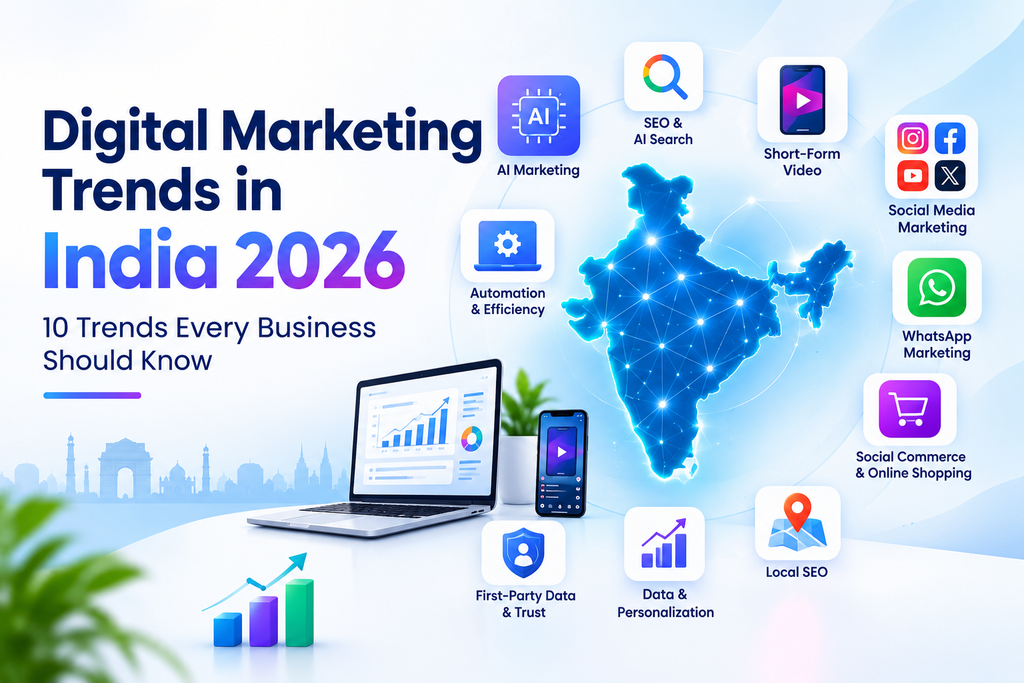
The major trends include AI-powered marketing, AI search, short-form video, social search, WhatsApp marketing, personalization, first-party data, social commerce, local SEO and AI-powered shopping.
Yes. SEO is still important, but it is changing. Businesses should focus on useful, trustworthy content that answers real customer questions rather than simply filling pages with keywords.
Small businesses can use AI for content ideas, social media drafts, customer support, market research, advertising variations and data analysis. Human review should remain part of the process.
Yes. Social platforms are important for brand discovery, customer engagement, video content, product discovery and lead generation. The right platform depends on where your target customers spend their time.
Local SEO helps your business appear when people search for products or services in a particular location, such as “digital marketing agency in Bhubaneswar” or “restaurant near me.”
Start with a good website, Google Business Profile, SEO, useful social media content and a simple system for handling leads. Once these basics are working, you can add paid advertising, AI automation and other advanced strategies.